Classic riffs, power chord patterns, and minor anthems — the essential harmonic vocabulary of rock music.
Rock music draws from blues, folk, and classical traditions — but it turns up the volume, strips down the complexity, and drives everything forward with relentless energy. These are the chord progressions that defined rock guitar.
Classic Rock Progressions
The 12-Bar Blues
I – I – I – I – IV – IV – I – I – V – IV – I – V
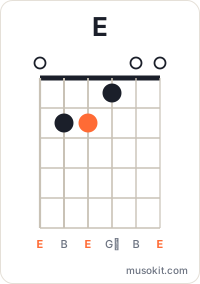
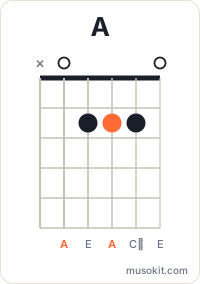
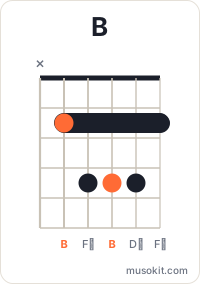
In E: E – E – E – E – A – A – E – E – B – A – E – B
The DNA of rock music. 12 bars, three chords, the same loop that spawned Chuck Berry, Elvis, and Hendrix. Learn it in A and E — most rock jam sessions start here.
🎸 Heard in: "Johnny B. Goode", "Rock Around the Clock", "Hound Dog", "La Grange" (ZZ Top)
Three chords, millions of songs. The most portable progression in rock — it works with power chords, open chords, barre chords, or a capo. Add a vi at any point for variety.
🎸 Heard in: "Wild Thing", "Twist and Shout", "Knockin' on Heaven's Door", "Brown Eyed Girl"
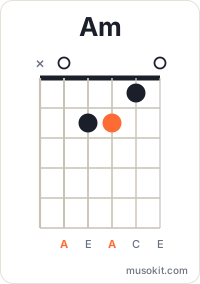
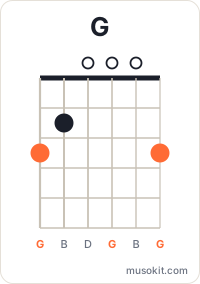
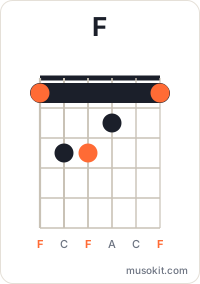
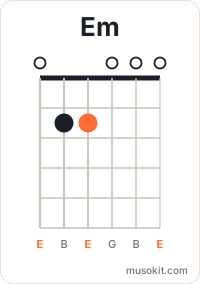
In A minor: Am – G – F – G | In E minor: Em – D – C – D
The backbone of anthemic rock. The oscillation between VII and VI creates a sense of mounting energy. The i start gives it that darker, more urgent quality than major progressions.
🎸 Heard in: "Stairway to Heaven" (verse), "All Along the Watchtower", "Sultans of Swing", "Comfortably Numb"
The borrowed VII (from the parallel minor key) gives this progression a harder, grittier edge than a straight I–IV–V. Incredibly common in hard rock and classic rock — sounds massive with power chords and distortion.
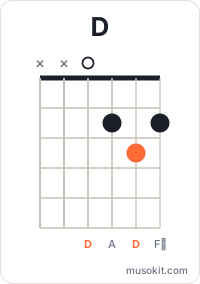
🎸 Heard in: "Back in Black" (E–D–A), "Highway to Hell", "Sweet Home Alabama", "Smoke on the Water"
The same four chords as the I–V–vi–IV pop progression, but starting from the minor. Grunge and alternative rock adopted this heavily in the 90s — it has a melancholic, introspective quality that suits heavy guitar sounds.
🎸 Heard in: "Creep" (Radiohead), "Zombie" (The Cranberries), "Losing My Religion" (REM)
A compact loop that feels complete — the V at the end creates tension that resolves back to I at the start. Works brilliantly for verse sections, especially when the chorus uses a different progression.
🎸 Heard in: "Wish You Were Here" (verses), "Heart of Gold", countless country-rock songs
Most rock songs are built on I–IV–V, i–VII–VI–VII, or the 12-bar blues. Power chord versions of these progressions strip away the third, giving that raw, distorted rock sound.
What is a power chord progression?
A power chord is just the root and fifth of a chord (no third), notated as '5' (e.g., E5, A5). Power chord progressions use these two-note shapes across rock and metal — they sound aggressive and cut through distortion cleanly.
What is the most common rock progression?
The I–IV–V is the most common across rock, blues-rock, and classic rock. In E it gives E–A–B, the backbone of countless guitar-based songs. The minor i–VII–VI–VII is the second most common, used in arena rock and hard rock.
Can I use minor progressions in rock music?
Yes — minor progressions are very common in rock. The i–VII–VI–VII (Am–G–F–G) is used in countless rock anthems. Minor keys give rock music a darker, heavier feel compared to major progressions.