Music Theory · 2026-05-22
Pop Chord Progressions
Pop music is built on a small set of highly effective chord progressions that work in almost any key. Understanding these patterns lets you write songs faster, transpose them effortlessly, and recognise the harmony in songs you hear.
Pop chord progressions are repeating four-chord patterns drawn from the diatonic chords of a major or minor key. The most common is I–V–vi–IV (e.g. C–G–Am–F), which appears in hundreds of hit songs across every decade. Other widely-used pop patterns include vi–IV–I–V, I–IV–vi–V, and the two-chord loop I–V repeated throughout a song.
In C:
In G:
Heard in: "Someone Like You" (Adele), "Let Her Go" (Passenger), "Africa" (Toto)
The most popular chord progression in modern pop. The move from V to vi is emotionally satisfying — the ear expects resolution to I but gets the relative minor instead, creating a bittersweet feeling.
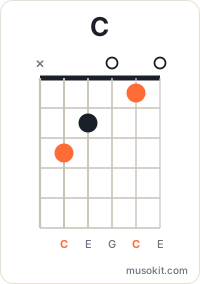
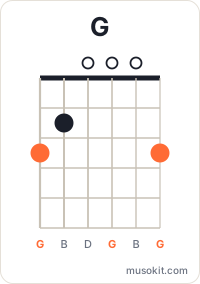
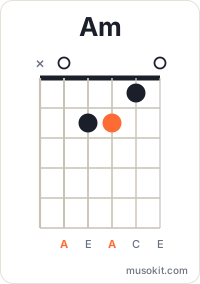
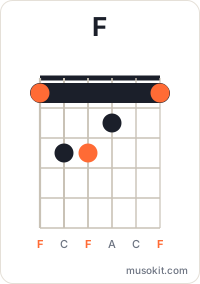
In C:
In G:
Heard in: "Stand By Me", "Earth Angel", countless 50s and 60s songs
The classic "doo-wop" progression. More predictable than I–V–vi–IV but deeply familiar. The vi and IV create a warm, nostalgic quality before V leads confidently back to I.
In C:
In G:
Heard in: Countless pop, rock, and country songs
The simplest complete harmonic statement. Home → lift → tension → resolution. It ends rather than loops, making it ideal for song sections that need a clear cadence.
In C:
In G:
Heard in: "Don't Stop Believing" (Journey), "Eye of the Tiger" (Survivor)
The iii chord adds colour between tonic and subdominant. It shares notes with both I and V, making it a smooth connector that adds sophistication without complexity.
Want to hear these progressions in any key? The MusoKit chord progression generator plays them back instantly.
Try the Chord Progression Generator →