Soulful patterns from classic Motown to modern neo-soul — the harmonic vocabulary of R&B.
R&B harmony sits at the crossroads of gospel, jazz, and blues. What makes it distinctive is the use of extended chords — adding 7ths, 9ths, and 11ths to familiar patterns — and the emphasis on smooth, expressive voice leading between them.
Classic Soul & Motown Progressions
The Soul ii–V–I
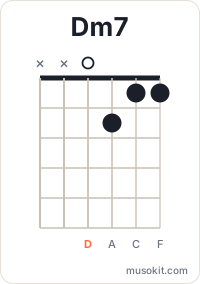
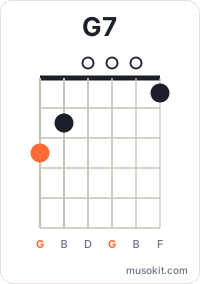
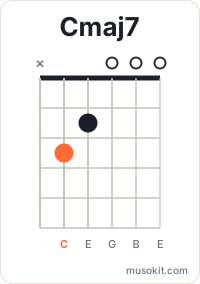
ii7 – V7 – Imaj7
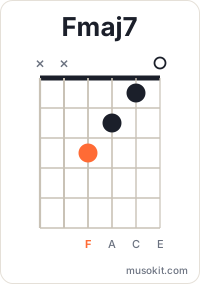
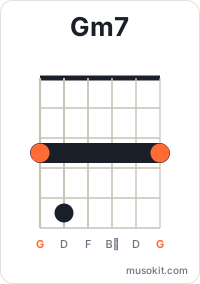
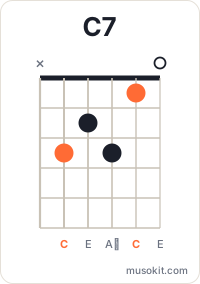
In C: Dm7 – G7 – Cmaj7 | In F: Gm7 – C7 – Fmaj7
Soul borrowed the ii–V–I from jazz and made it sing. The key difference: use rich extended voicings — Dm9 instead of Dm, G13 instead of G7, Cmaj9 instead of Cmaj7. The result is immediately warmer and more soulful than the plain triads.
The heartbeat of gospel and its R&B descendants. Simple on paper but profound in execution — the feeling comes from the rhythmic delivery, the voice leading in the inner parts, and the call-and-response between instruments and vocals.
🎶 Heard in: "I'll Take You There" (The Staple Singers), countless gospel and soul classics
A descending stepwise progression that flows naturally over a scalar bass line. Each chord is a step closer to home — creates a sense of arrival and warmth. Add 7ths to each chord for extra richness.
🎶 Heard in: "My Girl" (The Temptations — verse), many Motown productions with descending bass lines
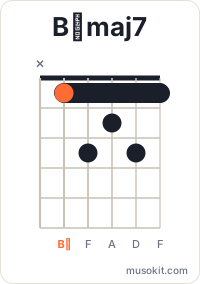
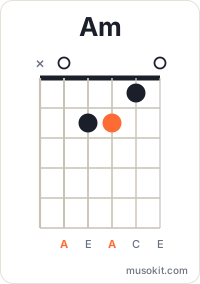
The contemporary R&B standard. Minor 7th tonic, smooth movement to the major VII, landing on a lush major 7th VI chord before cycling back. Add 9ths and 11ths throughout. This is the sound of D'Angelo, Erykah Badu, and Frank Ocean.
🎶 Heard in: D'Angelo "Brown Sugar", Erykah Badu "On & On", many SZA and H.E.R. songs
A cyclical minor progression that borrows both from jazz and classical harmony. The movement from iv to VII to III creates a satisfying descending bass line feel. Very popular in contemporary R&B productions.
🎶 Heard in: Numerous R&B productions from the 2010s–2020s; common in Frank Ocean, The Weeknd productions
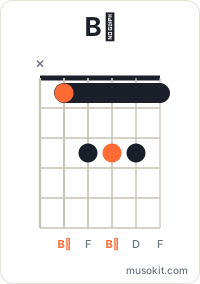
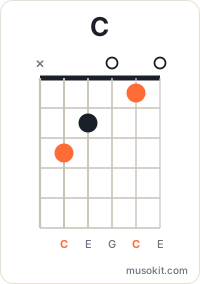
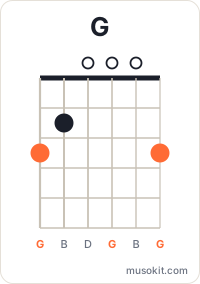
All four chords in the key — a complete diatonic loop. Play it slowly with extended voicings and it becomes hypnotic. Speed it up and it becomes energetic. The jazz foundation of contemporary radio R&B.
🎶 Heard in: Jhené Aiko, Alicia Keys, many John Legend productions
R&B uses extended chords (7ths, 9ths, 11ths) over familiar progressions. Common patterns include ii–V–I, i–VII–VI–V, and IV–iii–ii–I. Neo-soul adds more complex voice leading and chromatic passing chords.
What makes R&B chord progressions sound soulful?
The soulful quality comes from extended chord tones (adding 7ths, 9ths), smooth voice leading between chords, and the interplay between minor and major. Using minor 7th and major 7th chords instead of plain triads adds richness immediately.
What chords are common in neo-soul?
Neo-soul relies heavily on major 7th chords, minor 9th chords, and dominant 13th chords. The complex voicings over relatively simple progressions — it's the chord quality and voice movement that creates the neo-soul sound.
What key is most R&B music in?
R&B and soul are frequently recorded in flat keys like Bb, Eb, Ab, and F — these keys suit the human voice range and are natural for horn players. Guitar-heavy R&B tends toward A, D, and G.