Music Theory · 2026-05-22
Jazz Chord Progressions
Jazz harmony is built almost entirely on ii–V–I motion. Mastering this one progression — and recognising it when it appears in different keys — unlocks the harmonic logic of virtually every jazz standard ever written.
Jazz chord progressions are built primarily on ii–V–I motion — a minor seventh chord moving through a dominant seventh to a major seventh chord. In C major, this is Dm7–G7–Cmaj7. The ii–V–I creates strong harmonic tension and resolution and forms the backbone of virtually every jazz standard. Other important jazz patterns include the I–vi–ii–V turnaround and the rhythm changes progression.
In C:
In G:
Heard in: Nearly every jazz standard — "Autumn Leaves", "All The Things You Are", "Blue Bossa"
The ii chord prepares the dominant, the V creates maximum tension, and the I resolves it completely. The strength of the resolution comes from the tritone in the V7 chord wanting to resolve inward to the I.
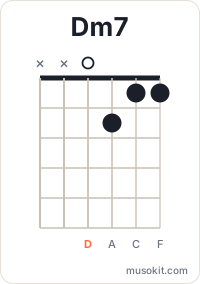
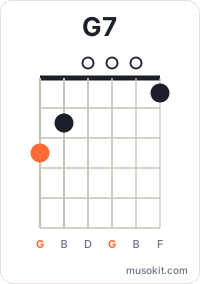
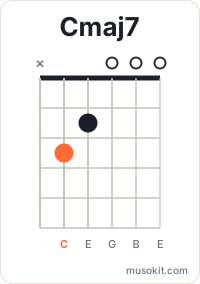
In C:
In G:
Heard in: "Rhythm Changes" (Gershwin's "I Got Rhythm"), "Blue Moon"
The jazz turnaround. Starts at home (I), dips through the submediant (vi), moves to the supertonic (ii), and pulls back through the dominant (V). It cycles perfectly — the V at the end wants to resolve to the I at the start.
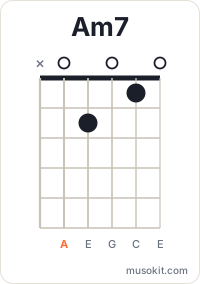
In C:
In G:
Heard in: "There Will Never Be Another You", "Satin Doll"
A more extended turnaround. The iii and VI are secondary dominants — VI resolves to ii, and ii leads to V. This creates a cycle-of-fifths motion through four chords before the V resolves home.
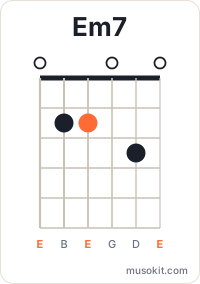
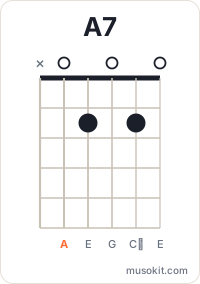
In C:
In G:
Heard in: "Misty" (Erroll Garner), many ballad standards
A full jazz phrase descending through the cycle of fifths. The IV introduces the subdominant color, iii–VI is a brief detour through the relative minor area, before the ii–V–I clinches the resolution.
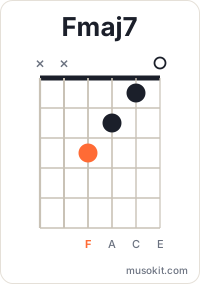
Want to hear these progressions in any key? The MusoKit chord progression generator plays them back instantly.
Try the Chord Progression Generator →