Music Theory · 2026-05-22
Folk & Acoustic Guitar Chord Progressions
Folk music is harmonically honest. Where jazz adds extensions and bebop substitutions, folk strips harmony down to its emotional essence — often three or four chords that sit in the guitar's natural resonant keys and let the melody and story carry the weight.
In G:
In D:
Heard in: Traditional folk ballads, Bob Dylan early work, countless sea shanties
The simplest complete harmonic journey. In guitar-friendly keys (G, D, A, E), these three chords feel natural under the hand and resonate beautifully with open strings.
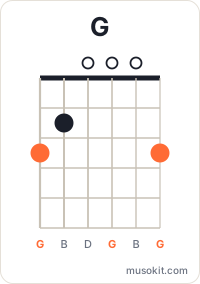
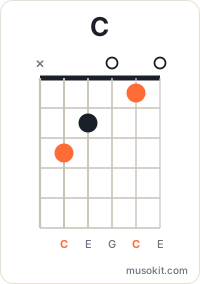
In G:
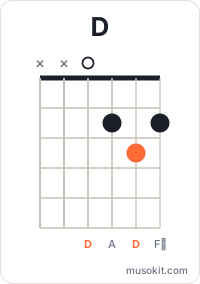
In D:
Heard in: "Hey Jude" (Beatles), "Blowin' in the Wind" (Dylan), "Free Fallin'" (Tom Petty)
Moving to V before IV reverses the expected direction and creates a rocking, comfortable back-and-forth feel. Perfect for strum patterns and singalongs.
In G:
In D:
Heard in: Irish and British folk music, "Sweet Home Alabama", "Knockin' on Heaven's Door"
The flat VII chord (borrowed from the Mixolydian mode) gives a Celtic, earthy quality. It avoids the leading tone pull of the major V chord, creating a modal, pastoral feeling instead of functional tension-resolution.
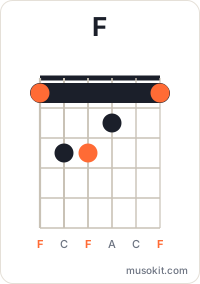
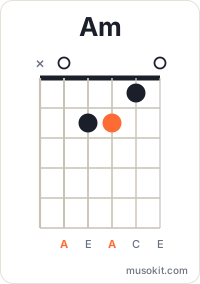
In A minor:
In E minor:
Heard in: "House of the Rising Sun", Nick Drake, Sufjan Stevens
The natural minor without the functional V chord. Moving to VII and back creates a rocking motion around the minor tonic. The VII never fully resolves — it just oscillates, giving folk ballads their melancholic staying power.
Want to hear these progressions in any key? The MusoKit chord progression generator plays them back instantly.
Try the Chord Progression Generator →