The Locrian mode is the 7th mode of the major scale. Starting on B, its notes are B – C – D – E – F – G – A, following the interval pattern H–W–W–H–W–W–W. It is the darkest and most dissonant of all modes, with both a ♭2nd and ♭5th degree. Its tonic chord is diminished, making it unstable as a tonal centre — it is rarely used as a home key but appears in metal and avant-garde music.
The Locrian Mode is the 7th mode of the major scale — a distinct scale with its own unique character, built by starting on the 7th note of any major scale. Here's everything you need to know about how it sounds, where it's used, and how to play it.
Notes in the Locrian Mode (starting on B)
Intervals: H–W–W–H–W–W–W
Formula: 1 b2 b3 4 b5 b6 b7
Locrian mode on B on piano and guitar
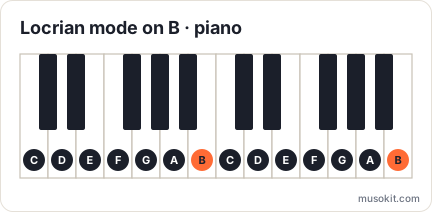
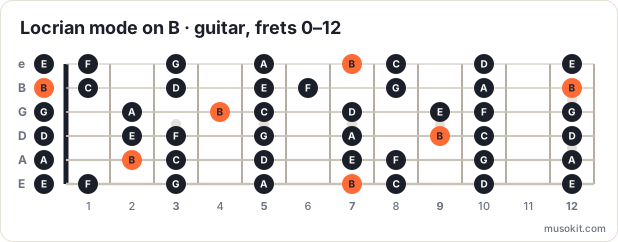
On guitar, the root B sits at fret 7 on the low E string and fret 2 on the A string. Start there, play every marked note up to the next B, and you have played the whole scale.
Scale degrees of Locrian mode on B
| Degree | Note | Interval from B |
|---|---|---|
| 1 | B | Root |
| ♭2 | C | Minor 2nd |
| ♭3 | D | Minor 3rd |
| 4 | E | Perfect 4th |
| ♭5 | F | Diminished 5th |
| ♭6 | G | Minor 6th |
| ♭7 | A | Minor 7th |
Character & Sound
The darkest and most dissonant of all modes — built on a diminished triad. The b5 creates natural instability. Rarely used as a tonal centre because it never sounds 'at rest'.
Locrian is natural minor with a lowered 2nd AND lowered 5th. The b5 makes the tonic chord diminished instead of minor — meaning there's no stable home chord, which is why Locrian rarely functions as a tonal centre.
Metal and avant-garde music where extreme darkness is needed. Locrian is used more as a passing scale than a key centre. The vii° chord in major keys is Locrian.
Björk 'Army of Me', Radiohead 'Paranoid Android' (sections), Steve Vai, dream theater passages
How to Build Any Locrian Mode
The Locrian Mode is the scale you get when you start on the 7th note of any major scale and play all the same notes to the next octave. For example:
- C major scale: C D E F G A B → start on B → gives you B Locrian (B – C – D – E – F – G – A)
- You can build a Locrian Mode starting on any note by applying the formula: 1 b2 b3 4 b5 b6 b7
Explore Every Mode with Audio
The MusoKit Scale Explorer lets you see and hear every mode in any key — guitar, piano, and bass.
Open Scale Explorer →Frequently Asked Questions
What is the Locrian Mode?
The Locrian Mode is the 7th mode of the major scale — built by starting on the 7th degree and using the same notes as the parent major scale. Starting on B: B – C – D – E – F – G – A.
What is the difference between Locrian Mode and the major scale?
Locrian is natural minor with a lowered 2nd AND lowered 5th. The b5 makes the tonic chord diminished instead of minor — meaning there's no stable home chord, which is why Locrian rarely functions as a tonal centre.
What music uses the Locrian Mode?
Metal and avant-garde music where extreme darkness is needed. Locrian is used more as a passing scale than a key centre. The vii° chord in major keys is Locrian.
Is Locrian Mode major or minor?
Locrian is technically neither major nor minor in the traditional sense — its tonic chord is diminished. This makes it unstable as a tonal centre and is rarely used as a 'home' key.
How do I practise the Locrian Mode?
Learn the notes starting on B (B – C – D – E – F – G – A), then play over a backing track using that root chord. Use the MusoKit Scale Explorer to see finger positions on guitar and piano.
See also: Scale Explorer · All 7 Modes Explained · Circle of Fifths