The Dorian mode is the 2nd mode of the major scale. Starting on D, its notes are D – E – F – G – A – B – C, following the interval pattern W–H–W–W–W–H–W. It is a minor mode with a raised 6th degree, giving it a brighter, more hopeful sound than natural minor. It is the most widely used mode in rock, jazz, and blues.
The Dorian Mode is the 2nd mode of the major scale — a distinct scale with its own unique character, built by starting on the 2nd note of any major scale. Here's everything you need to know about how it sounds, where it's used, and how to play it.
Notes in the Dorian Mode (starting on D)
Intervals: W–H–W–W–W–H–W
Formula: 1 2 b3 4 5 6 b7
Dorian mode on D on piano and guitar
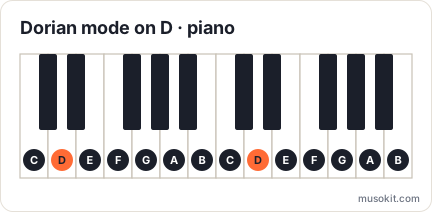
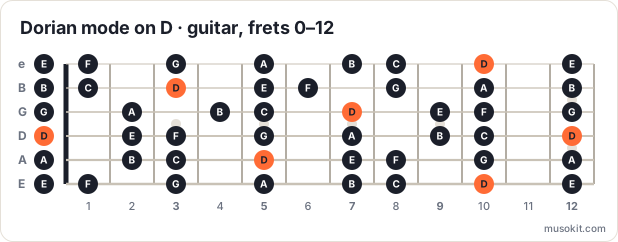
On guitar, the root D sits at fret 10 on the low E string and fret 5 on the A string. Start there, play every marked note up to the next D, and you have played the whole scale.
Scale degrees of Dorian mode on D
| Degree | Note | Interval from D |
|---|---|---|
| 1 | D | Root |
| 2 | E | Major 2nd |
| ♭3 | F | Minor 3rd |
| 4 | G | Perfect 4th |
| 5 | A | Perfect 5th |
| 6 | B | Major 6th |
| ♭7 | C | Minor 7th |
Character & Sound
Minor-feeling but with a raised 6th that gives it a brighter, more hopeful quality than natural minor. Often described as 'minor with a twist' — the raised 6th adds warmth.
Dorian is like natural minor but with a raised 6th degree. Natural minor has a b6 (flat 6th) — Dorian replaces that with a natural 6th, making it sound less dark and more versatile.
The workhorse of rock, jazz, and modal music. Carlos Santana, Miles Davis ('So What'), and countless jazz musicians live in Dorian. Also common in Celtic folk.
Santana 'Oye Como Va', Miles Davis 'So What', Daft Punk 'Get Lucky', Foo Fighters 'Everlong', The Beatles 'Eleanor Rigby'
How to Build Any Dorian Mode
The Dorian Mode is the scale you get when you start on the 2nd note of any major scale and play all the same notes to the next octave. For example:
- C major scale: C D E F G A B → start on D → gives you D Dorian (D – E – F – G – A – B – C)
- You can build a Dorian Mode starting on any note by applying the formula: 1 2 b3 4 5 6 b7
Explore Every Mode with Audio
The MusoKit Scale Explorer lets you see and hear every mode in any key — guitar, piano, and bass.
Open Scale Explorer →Frequently Asked Questions
What is the Dorian Mode?
The Dorian Mode is the 2nd mode of the major scale — built by starting on the 2nd degree and using the same notes as the parent major scale. Starting on D: D – E – F – G – A – B – C.
What is the difference between Dorian Mode and the major scale?
Dorian is like natural minor but with a raised 6th degree. Natural minor has a b6 (flat 6th) — Dorian replaces that with a natural 6th, making it sound less dark and more versatile.
What music uses the Dorian Mode?
The workhorse of rock, jazz, and modal music. Carlos Santana, Miles Davis ('So What'), and countless jazz musicians live in Dorian. Also common in Celtic folk.
Is Dorian Mode major or minor?
Dorian is a minor mode — its tonic chord is minor. The raised 6th makes it sound less dark than natural minor but it still has a minor feel.
How do I practise the Dorian Mode?
Learn the notes starting on D (D – E – F – G – A – B – C), then play over a backing track using that root chord. Use the MusoKit Scale Explorer to see finger positions on guitar and piano.
See also: Scale Explorer · All 7 Modes Explained · Circle of Fifths